Interventions
A. Several interventions
Vector-borne model with susceptible and infected hosts and vectors in a single population scenario, showing the effect of various interventions done at different time points.
For more information on how each intervention function works, check out the documentation for each function fed into newIntervention().
[1]:
from opqua.model import Model
Model initialization and setup
Create a new Model object
[2]:
model = Model() # Make a new model object.
Define a Setup for our system
Create a new set of parameters called my_setup to be used to simulate a population in the model. Use the default parameter set for a vector-borne model.
[3]:
model.newSetup(     # Create a new Setup.
    'my_setup',
        # Name of the setup.
    preset='vector-borne'
        # Use default 'vector-borne' parameters.
    )
We make a second setup called my_setup_2 with the same parameters, but duplicate the contact rate.
[4]:
model.newSetup(    # Create a new Setup.
    'my_setup_2',
        # Name of the setup.
    preset='vector-borne',
        # Use default 'vector-borne' parameters.
    contact_rate_host_vector=4e-1,
        # rate of host-vector contact events, not necessarily transmission, assumes
        # constant population density.
    )
Create a population in our model
Create a new population of 100 hosts and 100 vectors called my_population. The population uses parameters stored in my_setup.
[5]:
model.newPopulation(        # Create a new Population.
    'my_population',
        # Unique identifier for this population in the model.
    'my_setup',
        # Predefined Setup object with parameters for this population.
     num_hosts=100,
        # Number of hosts in the population with.
     num_vectors=100
        # Number of vectors in the population with.
    )
Manipulate hosts and vectors in the population
my_population starts with AAAAAAAAAA genotype pathogens.
[6]:
model.addPathogensToHosts(  # Add specified pathogens to random hosts.
    'my_population',
        # ID of population to be modified.
    {'AAAAAAAAAA':20}
        # Dictionary containing pathogen genomes to add as keys and
        # number of hosts each one will be added to as values.
    )
Define the interventions
At time 20, adds pathogens of genomes TTTTTTTTTT and CCCCCCCCCC to 5 random hosts each.
[7]:
model.newIntervention(  # Create a new Intervention.
    20,
        # time at which intervention will take place.
    'addPathogensToHosts',
        # intervention to be carried out, must correspond to the name of a method of
        # the Model object.
    [ 'my_population', {'TTTTTTTTTT':5, 'CCCCCCCCCC':5, } ]
        # arguments to be passed to the intervention method.
    )
At time 50, adds 10 healthy vectors to population.
[8]:
model.newIntervention(  # Create a new Intervention.
    50,
        # time at which intervention will take place.
    'addVectors',
        # intervention to be carried out, must correspond to the name of a method of
        # the Model object.
    [ 'my_population', 10 ]
        # arguments to be passed to the intervention method.
    )
At time 50, selects 10 healthy vectors from population
my_populationand stores them under the group ID10_new_vectors.
[9]:
model.newIntervention(  # Create a new Intervention.
    50,
        # time at which intervention will take place.
    'newVectorGroup',
        # intervention to be carried out, must correspond to the name of a method of
        # the Model object.
    [ 'my_population', '10_new_vectors', 10, 'healthy' ]
        # arguments to be passed to the intervention method.
    )
At time 50, adds pathogens of genomes GGGGGGGGGG to 10 random hosts in the
10_new_vectorsgroup (so, all 10 of them). The last10_new_vectorsargument specifies which group to sample from (if not specified, sampling occurs from whole population).
[10]:
model.newIntervention(  # Create a new Intervention.
    50,
        # time at which intervention will take place.
    'addPathogensToVectors',
        # intervention to be carried out, must correspond to the name of a method of
        # the Model object.
    [ 'my_population', {'GGGGGGGGGG':10}, '10_new_vectors' ]
        # arguments to be passed to the intervention method.
    )
At time 100, changes the parameters of my_population to those in
my_setup_2, with twice the contact rate.
[11]:
model.newIntervention(  # Create a new Intervention.
    100,
        # time at which intervention will take place.
    'setSetup',
        # intervention to be carried out, must correspond to the name of a method of
        # the Model object.
    [ 'my_population', 'my_setup_2' ]
        # arguments to be passed to the intervention method.
    )
At time 150, selects 100% of infected hosts and stores them under the group ID
treated_hosts. The third argument selects all hosts available when set to -1, as above.
[12]:
model.newIntervention(  # Create a new Intervention.
    150,
        # time at which intervention will take place.
    'newHostGroup',
        # intervention to be carried out, must correspond to the name of a method of
        # the Model object.
    [ 'my_population', 'treated_hosts', -1, 'infected' ]
        # arguments to be passed to the intervention method.
    )
At time 150, selects 100% of infected vectors and stores them under the group ID
treated_vectors. The third argument selects all vectors available when set to -1, as above.
[13]:
model.newIntervention(  # Create a new Intervention.
    150,
        # time at which intervention will take place.
    'newVectorGroup',
        # intervention to be carried out, must correspond to the name of a method of
        # the Model object.
    [ 'my_population', 'treated_vectors', -1, 'infected' ]
        # arguments to be passed to the intervention method.
    )
At time 150, treat 100% of the
treated_hostspopulation with a treatment that kills pathogens unless they contain a GGGGGGGGGG sequence in their genome.
[14]:
model.newIntervention(  # Create a new Intervention.
    150,
        # time at which intervention will take place.
    'treatHosts',
        # intervention to be carried out, must correspond to the name of a method of
        # the Model object.
    [ 'my_population', 1, 'GGGGGGGGGG', 'treated_hosts' ]
        # arguments to be passed to the intervention method.
    )
At time 150, treat 100% of the
treated_vectorspopulation with a treatment that kills pathogens unless they contain a GGGGGGGGGG sequence in their genome.
[15]:
model.newIntervention(  # Create a new Intervention.
    150,
        # time at which intervention will take place.
    'treatVectors',
        # intervention to be carried out, must correspond to the name of a method of
        # the Model object.
    [ 'my_population', 1, 'GGGGGGGGGG', 'treated_vectors' ]
        # arguments to be passed to the intervention method.
    )
At time 250, selects 85% of random hosts and stores them under the group ID
vaccinated. They may be healthy or infected.
[16]:
model.newIntervention(  # Create a new Intervention.
    250,
        # time at which intervention will take place.
    'newHostGroup',
        # intervention to be carried out, must correspond to the name of a method of
        # the Model object.
    [ 'my_population', 'vaccinated', 0.85, 'any' ]
        # arguments to be passed to the intervention method.
    )
At time 250, protects 100% of the vaccinated group from pathogens with a GGGGGGGGGG sequence in their genome.
[17]:
model.newIntervention(  # Create a new Intervention.
    250,
        # time at which intervention will take place.
    'protectHosts',
        # intervention to be carried out, must correspond to the name of a method of
        # the Model object.
    [ 'my_population', 1, 'GGGGGGGGGG', 'vaccinated' ]
        # arguments to be passed to the intervention method.
    )
Model simulation
[18]:
model.run(  # Simulate model for a specified time between two time points.
    0,      # Initial time point.
    400     # Final time point.
    )
Simulating time: 47.82778878187784, event: RECOVER_VECTOR
Simulating time: 78.3366736929209, event: RECOVER_VECTOR
Simulating time: 105.91879303271841, event: CONTACT_HOST_VECTOR
Simulating time: 118.47279407649962, event: RECOVER_HOST
Simulating time: 131.35992383183006, event: CONTACT_VECTOR_HOST
Simulating time: 142.51592961651278, event: CONTACT_HOST_VECTOR
Simulating time: 155.0493103157924, event: CONTACT_HOST_VECTOR
Simulating time: 166.15922138729405, event: CONTACT_VECTOR_HOST
Simulating time: 178.45033758585132, event: CONTACT_HOST_VECTOR
Simulating time: 191.46530199493813, event: CONTACT_HOST_VECTOR
Simulating time: 202.95353967543554, event: CONTACT_VECTOR_HOST
Simulating time: 215.14396460201561, event: RECOVER_VECTOR
Simulating time: 227.37567502659184, event: CONTACT_VECTOR_HOST
Simulating time: 239.10997595769174, event: CONTACT_VECTOR_HOST
Simulating time: 251.43868107426454, event: RECOVER_VECTOR
Simulating time: 270.88105008645147, event: CONTACT_HOST_VECTOR
Simulating time: 307.90286561294283, event: CONTACT_VECTOR_HOST
Simulating time: 357.4327138889326, event: CONTACT_VECTOR_HOST
Simulating time: 400.04897821206066 END
Output data manipulation and visualization
Create a table with the results of the given model history
[19]:
data = model.saveToDataFrame(
        # Creates a pandas Dataframe in long format with the given model history,
        # with one host or vector per simulation time in each row.
    'intervention_examples.csv'
        # Name of the file to save the data to.
    )
data
Saving file...
[Parallel(n_jobs=8)]: Using backend LokyBackend with 8 concurrent workers.
[Parallel(n_jobs=8)]: Done   2 tasks      | elapsed:    0.4s
[Parallel(n_jobs=8)]: Batch computation too fast (0.18432052612304692s.) Setting batch_size=2.
[Parallel(n_jobs=8)]: Done   9 tasks      | elapsed:    0.4s
[Parallel(n_jobs=8)]: Done  16 tasks      | elapsed:    0.4s
[Parallel(n_jobs=8)]: Batch computation too fast (0.016484975814819336s.) Setting batch_size=4.
[Parallel(n_jobs=8)]: Done  26 tasks      | elapsed:    0.4s
[Parallel(n_jobs=8)]: Done  44 tasks      | elapsed:    0.5s
[Parallel(n_jobs=8)]: Batch computation too fast (0.030623912811279297s.) Setting batch_size=8.
[Parallel(n_jobs=8)]: Done  76 tasks      | elapsed:    0.5s
[Parallel(n_jobs=8)]: Done 120 tasks      | elapsed:    0.5s
[Parallel(n_jobs=8)]: Batch computation too fast (0.043166160583496094s.) Setting batch_size=16.
[Parallel(n_jobs=8)]: Done 224 tasks      | elapsed:    0.6s
[Parallel(n_jobs=8)]: Batch computation too fast (0.04822254180908203s.) Setting batch_size=32.
[Parallel(n_jobs=8)]: Done 408 tasks      | elapsed:    0.8s
[Parallel(n_jobs=8)]: Batch computation too fast (0.08920669555664062s.) Setting batch_size=64.
[Parallel(n_jobs=8)]: Done 792 tasks      | elapsed:    0.9s
[Parallel(n_jobs=8)]: Batch computation too fast (0.16597485542297363s.) Setting batch_size=128.
[Parallel(n_jobs=8)]: Done 1528 tasks      | elapsed:    1.4s
[Parallel(n_jobs=8)]: Done 3192 tasks      | elapsed:    2.2s
[Parallel(n_jobs=8)]: Done 5368 tasks      | elapsed:    3.2s
[Parallel(n_jobs=8)]: Done 7449 tasks      | elapsed:    3.6s
[Parallel(n_jobs=8)]: Done 8243 tasks      | elapsed:    3.6s
[Parallel(n_jobs=8)]: Done 8591 tasks      | elapsed:    3.6s
[Parallel(n_jobs=8)]: Done 8822 tasks      | elapsed:    3.6s
[Parallel(n_jobs=8)]: Done 9064 out of 9079 | elapsed:    3.6s remaining:    0.0s
[Parallel(n_jobs=8)]: Done 9079 out of 9079 | elapsed:    3.6s finished
...file saved.
/home/acs98/miniconda3/envs/opqua/lib/python3.9/site-packages/opqua/model.py:1008: DtypeWarning: Columns (5) have mixed types.Specify dtype option on import or set low_memory=False.
  data = saveToDf(
[19]:
| Time | Population | Organism | ID | Pathogens | Protection | Alive | |
|---|---|---|---|---|---|---|---|
| 0 | 0.0 | my_population | Host | my_population_0 | AAAAAAAAAA | NaN | True |
| 1 | 0.0 | my_population | Host | my_population_1 | NaN | NaN | True |
| 2 | 0.0 | my_population | Host | my_population_2 | NaN | NaN | True |
| 3 | 0.0 | my_population | Host | my_population_3 | NaN | NaN | True |
| 4 | 0.0 | my_population | Host | my_population_4 | NaN | NaN | True |
| ... | ... | ... | ... | ... | ... | ... | ... |
| 1898145 | 400.0 | my_population | Vector | my_population_105 | GGGGGGGGGG | NaN | True |
| 1898146 | 400.0 | my_population | Vector | my_population_106 | NaN | NaN | True |
| 1898147 | 400.0 | my_population | Vector | my_population_107 | NaN | NaN | True |
| 1898148 | 400.0 | my_population | Vector | my_population_108 | NaN | NaN | True |
| 1898149 | 400.0 | my_population | Vector | my_population_109 | NaN | NaN | True |
1898150 rows × 7 columns
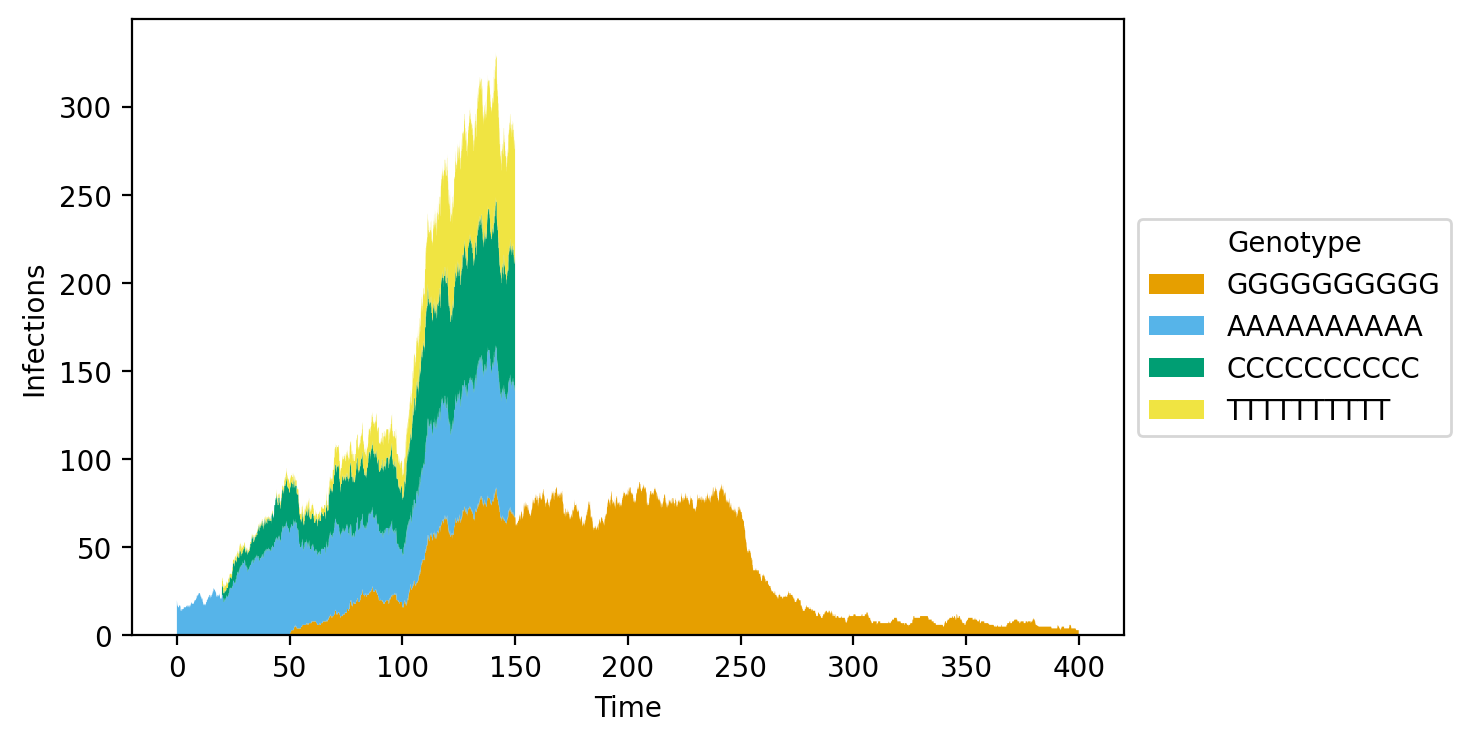
Create a plot to track pathogen genotypes across time
[20]:
plot_composition = model.compositionPlot(
        # Create a plot to track pathogen genotypes across time.
    'intervention_examples_composition.png',
        # Name of the file to save the plot to.
    data
        # Dataframe with model history.
    )
1 / 4 genotypes processed.
2 / 4 genotypes processed.
3 / 4 genotypes processed.
4 / 4 genotypes processed.
Create a compartment plot
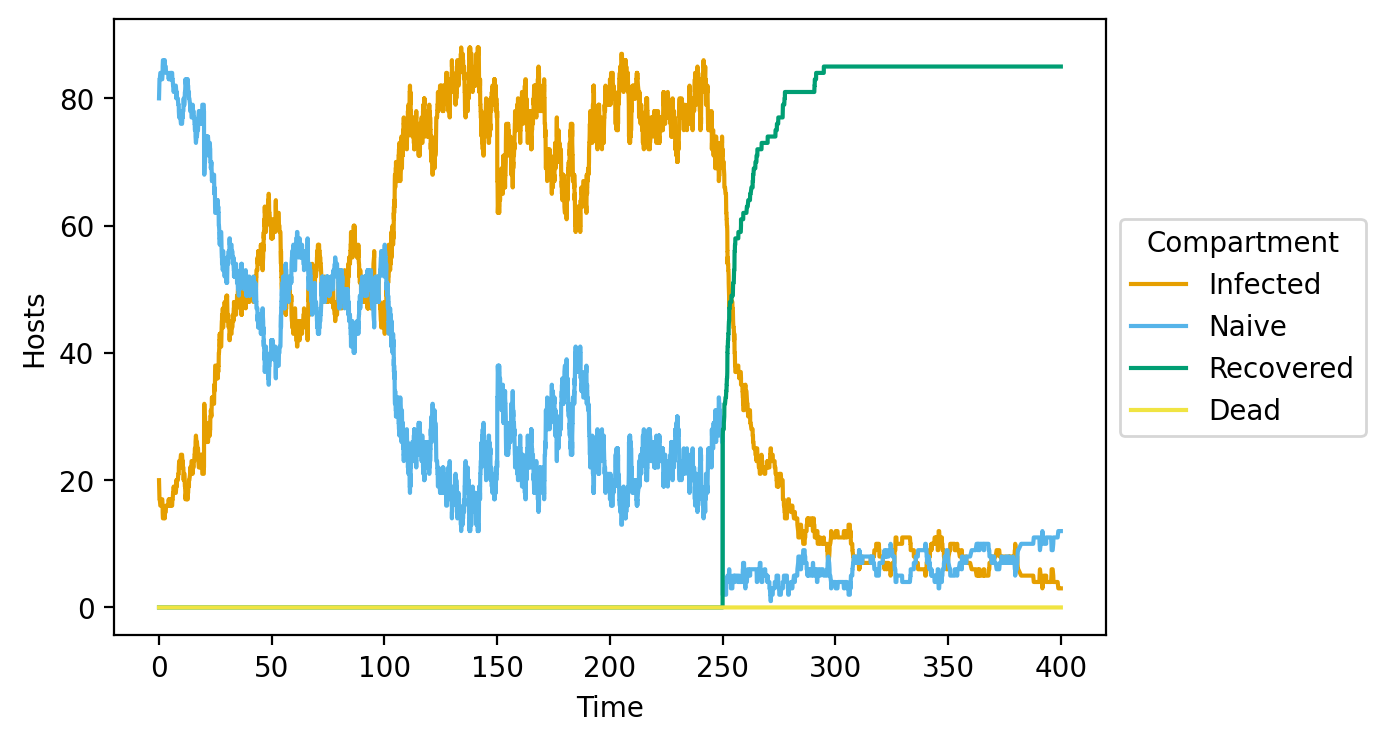
Plot the number of susceptible and infected hosts in the model over time.
Notice the total number of infections in the composition plot can exceed the number of infected hosts in the compartment plot. This happens because a single host infected by multiple genotypes is counted twice in the former, but not the latter.
[21]:
plot_compartments = model.compartmentPlot(
        # Create plot with number of naive, infected, recovered, dead hosts/vectors vs. time.
    'intervention_examples_compartments.png',
        # File path, name, and extension to save plot under.
    data
        # Dataframe with model history.
    )